
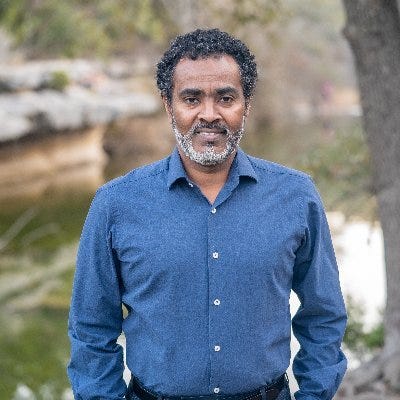
Photo: Husam Mahjoub
thinking with: is a series of conversations rooted in study as a collective practice that exceeds institutional forms even as it moves through them. Engaging questions of collapse, abolition, solidarity, and survival, the series foregrounds thinking as something done together, in the midst of constraint and struggle. Conversation here is not a platform for positions, but a practice of holding open ways of instituting otherwise.
Husam Mahjoub is a cofounder of Sudan Bukra, an independent nonprofit TV channel watched by millions of Sudanese viewers. A telecom professional and activist, he holds master’s degrees from the London Business School and Georgia Tech and currently lives in Austin, Texas. He has published articles on politics, human rights, the economy, culture, and international affairs.
Husam facilitated our Media Literacy Intensive: Narrating Sudan: Histories, Silences, and the Work of Telling with Husam Mahjoub in February this year. We revisit some of the questions and discussions as a continued conversation to think through Sudan.
Meenakshi Thirukode (MT): We often encounter Sudan through fragments: a breaking-news headline, an image, a statistic, a moment of violence. What gets lost when Sudan is encountered primarily through these fragments? What histories and contexts do we need to hold alongside the present in order to understand what is happening?
Husam Mahjoub (HM): I often start with Al-Mugran in Khartoum, one of Sudan’s most beautiful natural landmarks, where the Blue Nile, originating in Ethiopia, meets the White Nile, originating in Lake Victoria, to form the River Nile, which flows north through the deserts of Sudan and Egypt to the Mediterranean. The Blue Nile owes its name to Sudanese Arabic, where azrag, “blue,” also means black, a reference to its darker water, which runs alongside the lighter White Nile for several kilometers before the two merge.
That confluence describes Sudan well. Throughout its long history, Sudan has been a meeting place of cultures, peoples, histories, climates and rich natural resources. It is where the desert gives way to the savanna and then the forest, where people from Arabia mixed with African peoples, and where the country opened its arms to people from elsewhere. It is where ancient Nubian religions, Judaism, Christianity, Islam and many African and local faiths coexisted.
This richness is why I see Sudan as both unique and similar to other countries and peoples. Its story has features found nowhere else, and it also holds experiences that people across the world will recognize as their own. To understand Sudan, we need to hold both.
Sudan’s uniqueness begins with its ancient past. It is a land with thousands of years of history, home to Nubian civilizations that were highly advanced in antiquity and to centralized states and varied political and social structures. It has a long tradition of coexistence among its peoples and faiths, and it sits on the migration routes linking the Arabian Peninsula with every part of Africa.
Its modern history is unique too. Turco-Egyptian rule under Muhammad Ali, beginning in 1821, shaped the borders of the Sudan we know today. In the 1880s, a national revolution led by Muhammad Ahmad Al-Mahdi drove out the Turco-Egyptian rulers and the British officers who served them. At the Battle of Omdurman in 1898, the Anglo-Egyptian army under British command killed more than 10,000 Sudanese fighters in a few hours, in one of the most brutal early uses of the machine gun. Britain and Egypt then ruled Sudan jointly in name, with Britain holding real power, until Sudan became one of the first countries in Sub-Saharan Africa to win independence, on January 1, 1956. Sudan suffered one of Africa’s first military coups in 1958, and it was also among the first countries where popular revolutions toppled dictatorships, in 1964, in 1985 and again in 2019.
Sudan is also similar, and I want people to relate to it through what its history shares with theirs. Colonialism is one example. Colonizers drew Sudan’s borders and left the modern state with disputed borders with several of its neighbors. They governed through divide and rule, deepened divisions between communities in ways that hindered the building of a shared nation, and developed only the regions and peoples that served colonial interests.
The post-colonial story is familiar as well. After independence, Sudanese elites inherited the colonial powers’ role and continued their projects and methods with little change, laying the ground for the grievances behind Sudan’s civil wars. This history, which reaches well beyond the current war, will be familiar to peoples across the world.
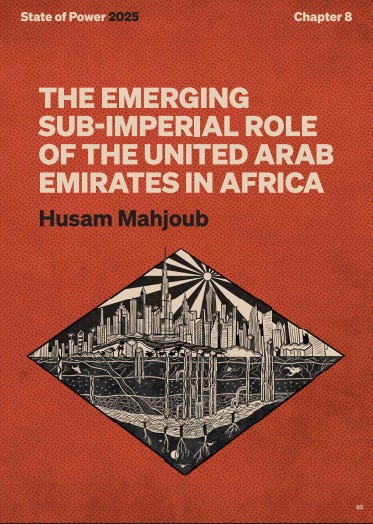
Today, the two sides of Sudan’s story come together. The country is becoming a laboratory for sub-imperial powers, above all the United Arab Emirates, whose interference has pushed the state close to collapse. This is similar to what others have lived through, because the UAE and other sub-imperial powers have done the same elsewhere, including in Africa. It is also unique, because in this war the UAE, enabled by the United States and Western Europe, is experimenting with new methods.
These are the things I want people to know about Sudan, a country unique in its history and similar to so many others in what it has endured.
MT: One of the questions behind this media literacy intensive is: who gets to know what is happening on the ground, and how does that knowledge travel? Could you speak about the infrastructures—media, humanitarian, political, community-based or otherwise—that enable or restrict the movement of information about Sudan?
HM: Control over information, knowledge, news, and media has been one of the defining features of modern Sudanese history. At independence, the Sudanese state inherited institutions that the British had built to serve colonial needs. Like colonizers elsewhere, they cared little for the present or future of the peoples they ruled. Sudan was a vast country of diverse peoples speaking hundreds of languages, most of them unwritten, with only the bare minimum of roads, railways, electricity, and broadcasting infrastructure. The elite that controlled power and wealth in the capital also controlled the narrative, deciding what was produced, how, for whom, and in which language. With illiteracy widespread, that control extended across news, culture, the arts, and even entertainment.
Newspapers established under colonial rule published in Arabic and were distributed by road, rail, and air to the capital and the main towns. For most of the country they were out of reach because of language, distance, and literacy, and because a narrow class decided who got to write in them. After independence, important experiments pushed against this. Regional newspapers and magazines spoke directly to local populations, and the labor movement, the women’s movement, and some political parties published national papers that tried to carry more diverse voices than those of the educated center.
For most of Sudan’s post-independence history, radio was the main source of news, information, and knowledge. Battery-powered sets reached places without electricity, regional stations existed alongside the national one, and people could also tune in to international broadcasters. Within Sudan, however, the radio stations belonged to the government, so whoever held power controlled what people heard. This is why every coup followed the same script. The plotters seized the army headquarters, the main bases in the capital, and the national radio and television station. For generations, Sudanese knew a coup was underway when regular programming gave way to military marches. Television came later and reached fewer people because of limits on electricity and transmission, until satellite broadcasting overcame some of those barriers.
Each of Sudan’s three dictatorships, under Abboud from 1958 to 1964, Nimeiri from 1969 to 1985, and Bashir from 1989 to 2019, placed the press under security control, and each successful coup was followed by the banning of newspapers. Under Bashir, newspapers and even the private radio and television stations that were eventually licensed operated under heavy surveillance. His security service ran an “electronic jihad” unit that carried out surveillance and spread propaganda, misinformation, and disinformation. Sudanese people responded as they always have. They kept knowledge alive through oral history, one-to-one and communal storytelling, poetry, and other literary forms of recording what happened to them. They also exploited whatever narrow openings the licensed press allowed and published underground newspapers, most of them political.
From around 2010, social media became the main channel through which information was produced and shared. WhatsApp became central to daily communication, followed by Facebook and, to a lesser extent, X and Instagram. Cost, electricity, and network coverage still exclude many Sudanese, but millions of people have phones that can reach these platforms. Social media allowed far more people and organizations to publish outside the control of the regime and its security services, and outside the financial barriers of traditional media. It also gave new life to older oral and poetic forms. Yet it opened the door to misinformation, disinformation, and manipulation, increasingly by forces with more money, power, and organization than ordinary citizens.
That manipulation intensified after the December 2018 revolution. Alongside Sudan’s own security apparatus, the security services of the UAE and Egypt entered the field. Less than five weeks after Bashir fell, RSF leader Hemedti signed a multimillion-dollar contract with Dickens & Madson, a Canadian lobbying firm run by former Israeli intelligence officer Ari Ben-Menashe, to promote the Transitional Military Council and smear the civilian forces. Meta later removed networks of fake accounts linked to companies in Egypt, the UAE, and Russia that targeted Sudan’s online space. The civilian-led transitional government never took the media front seriously, and Sudanese people were left exposed. Since the war began, polarization and the erosion of trust have deepened, and recent reports describe sophisticated Emirati-financed influence networks that use AI. Both sides have also cut internet and telecommunications services, continuing a tool of repression that the Bashir regime perfected.
Mainstream outlets offer little relief. Most Arabic-speaking audiences rely on Al Jazeera, Al Arabiya, and Sky News Arabia, which reflect the positions of Doha, Riyadh, and Abu Dhabi respectively. Western media treats Sudan as unprofitable airtime that can be ignored without consequence, and serious coverage usually depends on the commitment of individual correspondents. The international humanitarian system adds its own filter, since it answers to donors abroad and frames the war as a technical and distant crisis to be managed.
Against all this, Sudanese people have kept building their own infrastructure. In the final years of Bashir’s rule and during the transition, community and citizen media projects worked to lower the barriers for ordinary citizens across Sudan. These included Sudan Bukra, which I co-founded with fellow telecom engineers to get around internet shutdowns. Such projects helped people tell stories about their daily lives, aspirations, and problems in the language they speak, and they carried those stories to regions that had never been present in Sudanese media. Since the war began, independent outlets such as Atar have covered it across the whole country for all Sudanese, while Emergency Response Rooms, Resistance Committees, and diaspora networks document what happens in their communities. These efforts continue a tradition that has run through Sudan’s history since independence.
MT: For journalists, writers and artists working from outside Sudan, there is a particular responsibility in approaching a conflict they may not have direct access to. What does it mean to work with testimony, documentation and knowledge produced by people on the ground without extracting from it or speaking over it?
HM: I think it is important first to put Sudan in perspective. Sudan has its own particulars, and from a distance it can seem remote and impossibly complex. In many ways, though, it resembles contexts that journalists, writers, and artists already know, and almost anyone in the world can relate to some part of what is happening there. Those who are serious about covering Sudan can start by placing it alongside stories closer to their own experience, and that comparison helps untangle much of its complexity. Anyone who has covered or followed a war in recent years understands how organized, well-funded disinformation campaigns work. They will also recognize the familiar ways global powers manage conflicts in Africa, Asia, Latin America, and even Europe. Applying that understanding to Sudan means reading mainstream international coverage critically and comparing it with what is known from other conflicts, to see whether the same patterns appear.
It is essential to seek out stories told by ordinary Sudanese citizens. But there is a trap in assuming that anything local, community-based, or citizen-produced is automatically true. The war has deepened divisions that already existed among Sudanese people and among our political and social forces. A couple of years ago, I began to see how hard, and how dangerous, it had become for Sudanese to talk about the war among ourselves. Sometimes it is impossible even within a single family or among old friends, because our views have diverged so sharply. Many Sudanese now live inside one of two opposed realities, each with its own facts. A testimony can be sincere and still be shaped by that polarization, so working responsibly with what people on the ground produce means respecting their accounts while still examining them.
When I tried to address this problem among Sudanese, I suggested a few principles, and I think they apply equally to anyone working from outside.
The first is to look critically at everything you read and hear. Given how far disinformation has spread, treat what circulates on social media as most likely incorrect until it is proven otherwise, and treat what appears in mainstream media as most likely biased until proven otherwise. Verify claims across sources aligned with different parties, and be honest about what remains uncertain, since information about this war keeps emerging and changing.
The second, and in my view the most important, is to hold a set of values that you will not violate, whatever happens. A human life is a human life. The loss of a human life is a crime wherever it happens and whoever is responsible. A war crime is a war crime whether it is committed by the RSF or the army, in Sudan or anywhere else. Another value is to judge people by the truth, never the truth by people. A claim does not become true because a respected leader, a familiar outlet, or someone from your own side makes it, and it does not become false because it comes from someone you oppose. As Imam Ali ibn Abi Talib put it fourteen centuries ago, “Truth and falsehood are not known by the standing of men. Know the truth, and you will know its people.” These values should guide how you receive information, how you examine it, how you form your own views, and how you write, produce, and share your work.
The third is to accept that things are complex and that people have different degrees of agency, capacity, and responsibility. That means questioning those who hold the power and privilege to shape events and narratives, including generals, governments, foreign patrons, and the media they fund. It also means understanding the limits, motives, aspirations, and very human fears of people with far less power. A young fighter recruited from a village in Darfur, or a displaced family that repeats a rumor, does not carry the same responsibility as the officials in Abu Dhabi or Port Sudan who decide how the war is fought.
Avoiding extraction also has a practical side. Credit the Emergency Response Rooms, local journalists, and researchers whose work you rely on, pay them where possible, and give them a say in how their testimony is framed. Protect sources, especially where linking a name to sensitive information could expose someone to arrest or reprisal. And remember the millions of Sudanese who are not on the platforms where their war is debated, yet who live with the consequences of what is said there.
Overall, I would encourage anyone working on Sudan to begin by seeing it as part of a larger picture, one whose features are shared with struggles elsewhere. Once that basic understanding is in place, they can go deeper into what is particular to Sudan, and the testimony of people on the ground will make far more sense and receive the respect it deserves.
MT: Sudan has a long and complex history of colonialism, occupation, resistance, political violence and struggles over power and resources. How important is it to understand these histories when reporting on the present, and what happens when contemporary violence is presented as if it has emerged without history?
HM: Without history, the war becomes incomprehensible, and incomprehensible suffering is easy to ignore. It is also easy to dismiss as natural or expected, a judgment rooted in racism, however subtle. Every war in Sudan’s modern history has been reduced to a one-line identity label that the media can repeat easily. The southern civil war became a Muslim Arab north against a Christian African south, Darfur became Arabs against Africans, and the current war became two generals fighting for power. Each framing holds a fragment of truth and hides the rest. The Sudanese environmentalist and scholar Mohamed Suliman, who sadly passed away a few weeks ago, showed how Sudan’s conflicts began as struggles over land, water, and services, often breaking out a year after a drought. Elites and belligerents then reframe them as identity wars, because identity recruits fighters and wins supporters. Once reframed, these conflicts became far harder to resolve.
History also explains what drives the armed actors. Those carrying weapons in Sudan have been driven above all by the pursuit of money, power, and arms, with arms serving both as the guarantee of the other two and as a goal in themselves. To protect their share, they exploit religion, tribe, racism, real grievances, and uneven development. External greed has a long history as well. Muhammad Ali’s forces invaded Sudan in 1821 for gold, fighters, and the Nile, and those drivers still shape how outside powers approach the country. Today the UAE takes Sudan’s gold through Dubai, and it has used Sudanese fighters as mercenaries in Yemen. The British established the Gezira Scheme to supply Lancashire’s mills with Sudanese cotton, and they built railways to carry that cotton to Port Sudan on the Red Sea for export, while leaving the country unconnected to itself. The post-independence elite inherited that extractive structure intact.
The international community repeats its own patterns too. It keeps pursuing a liberal peacebuilding model that ends in sharing power and wealth among the belligerents, while the roots of the war go unaddressed and its victims emerge from it with no justice, no compensation, and no share in the peace. In 2003 the international community ignored the start of the Darfur war to protect the north-south negotiations, and today it leaves its Sudan policy to the Gulf states driving this war.
When violence is presented without history, coverage falls into false starting points. The endless debate over who fired the first shot on April 15, 2023, explains as little as the demand after October 7 that every conversation about Palestine begin with a condemnation. Ahistorical coverage also erases the December revolution, even though much of this war is a counterrevolution against Sudanese demands for freedom, peace, and justice. It flattens the war and overlooks the many wars within it. It also either leaves out foreign intervention altogether or treats every foreign actor as equally responsible.
MT: If we think of journalism, writing and art as ways of shaping what becomes visible and what enters public memory, what kinds of practices do we need to develop now? What should journalists, writers and artists be asking themselves before they begin to tell a story about Sudan?
HM: The first question is why I am telling this story, and for whom. Is the aim to mobilize, to inform, to pressure decision-makers, or to protect people? If the aim is only to convince by presenting the correct facts, experience shows that rarely works. People watched a genocide livestreamed from Gaza, and many did not change their positions. The purposes that endure are documenting and archiving, preserving lives and voices that dominant media ignore, building a collective memory that can support accountability and genuine reconciliation in the future, and building coalitions that can mobilize and apply pressure.
Before beginning, I would also ask whose interests my framing serves, where my story starts and what that starting point hides, and whether I have named the actors responsible, including the external ones, since vague references to “foreign backers” protect them. I would ask whether I am reproducing one of the two polarized realities of “Bal Bas,” meaning “only death,” and “No to War,” or the empty slogans that circulate between them, such as “the war will end through negotiation” with no political program attached. I would ask who is speaking in my piece and who is missing, and whether I have verified each claim across sources aligned with different parties while acknowledging what remains uncertain, since information about this war keeps emerging and changing.
The practices follow from these questions. Verify before publishing, however urgent it feels. State your sources openly and admit uncertainty. Read every outlet knowing whose money stands behind it, and cross-check across them. Spend less time on social media and treat what circulates there with suspicion. Fund and sustain independent media, because media supported by ordinary people is the only counterweight to the states and billionaires who own the platforms. Look critically at Gulf cultural soft power, including festivals, institutes, and sports sponsorships that help launder the reputations of states arming atrocities. And favor conversation over debate and point-scoring, so that discussion strengthens a community instead of draining it.
Writing also has to be slow. When I write, I can spend minutes on a single word because it carries a meaning I did not intend. That discipline is a dialogue with oneself, and it produces work that can reach people’s minds and hearts.
Finally, Sudan should be written as part of a connected world. Colombian mercenaries in Darfur, Emirati gold refineries, European migration deals that funded the RSF, a Canadian lobbying firm run by a former Israeli intelligence officer and hired by the generals, French, Canadian, and Serbian weapons in RSF hands, and US and UK governments that shield both the UAE and Israel all tie Sudan to struggles elsewhere. Readers in Bogotá, New York, London, or Delhi should come away understanding that this war runs through their own governments, economies, and media platforms, and that the Sudanese people, who rose against military rule in 1964, 1985, and 2018, remain the protagonists of their own history.
Thanks for reading “thinking with:” a series of conversations with critical thinkers of our time. If you like what you’ve read today, subscribe to School of Instituting Otherwise and support our work.