
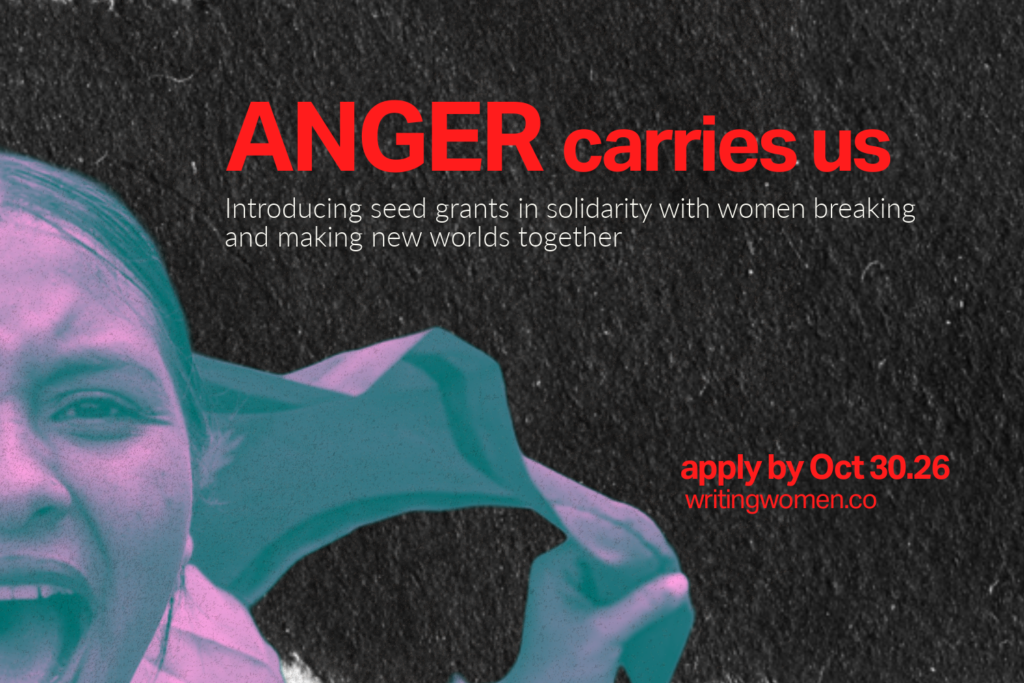
Writing Women is introducing seed grants for gender minorities breaking and making new worlds together. This fund is a solidarity response to those putting their lives, bodies, and energies into the fight for safer, more caring futures. We owe so much to those before us whose rage and anger paved our paths. Today across countries in South Asia we are witness to youth and student movements, and the outpour of fresh rage against old injustices.
Writing Women wants to support the different ways in which you are translating the rage in your bodies to make new paths. These are small scale funds that we hope to grow in time so we continue to seed rage driven good work. To extend the depth and reach of this work we are thrilled to collaborate with the School of Instituting Otherwise as a partner to expand the scope of our review, mentorship and engagement opportunities for selected projects.
Details and Application: Here
Anger is often treated as something to be managed, softened or overcome. But anger can also be a way of knowing, often guiding us when something is intolerable within the conditions we have inherited and are no longer liveable; we must begin imagining otherwise.
Across South Asia, feminist writers, artists, organisers and activists have long translated anger into ways of working, gathering, resisting and caring for one another. Much of this work takes place beyond formal institutions, often without adequate resources or recognition. It emerges from necessity, from relationships, from the knowledge carried across generations, and from the desire to make different futures possible informed by the unfolding of our present.
Anger Carries Us, the seed fund initiated by Writing Women, begins from an understanding of this work and the people who sustain it. It offers 3 seed grants of $ 1000 to gender minorities, including cis and trans women, and non-binary people working across South Asia, supporting projects that channel anger into feminist practice, collective organising and the making of safer, more caring futures.
School of Instituting Otherwise is glad to be partnering with Writing Women on this initiative, contributing to the review, mentorship and ongoing engagement around the selected projects.
For School of IO, this partnership opens up a question that sits at the heart of our work: What does it mean to support a practice, beyond funding a project?
Funding can create the conditions for something to begin. But what happens after the initial idea takes shape? What does it mean to hold a collective together, to make knowledge from lived experience, to document a struggle without extracting from it, or to sustain a practice when the urgency that brought people together has not disappeared?
We approach mentorship as a space to think through these questions together. Rather than offering a fixed model of what a successful project should look like, we are interested in creating conditions in which grantees can develop their own methods, recognise the knowledge they already hold, and find forms that respond to their particular contexts.
Our work at School of IO moves across learning, publishing, archives, storytelling and institution-building rooted in the values of resistance and liberation. These are not separate activities so much as interconnected ways of understanding how knowledge is made, shared and sustained and we do this primarily through collective study and writing workshops. We are interested in the spaces between formal education and lived experience, between an idea and the infrastructure required to hold it, and between individual practices and the collective worlds they might make possible.
Through this partnership, we imagine mentorship unfolding across three interconnected areas.
1. From Anger to Form
How does anger become a practice? What forms can it take, and what does it need in order to move from an impulse towards something tangible?
An idea might begin with a personal experience of injustice, a question that refuses to go away, a conversation among friends, or a collective need that has remained unaddressed. It might become a zine, a gathering, a campaign, a film, a writing project or a space for people to come together. It might also change shape along the way.
We want to make room for this process of becoming.
Through conversations, guided reflection and writing exercises, we hope to support grantees in articulating the questions that animate their work. What is the urgency they are responding to? Who are they working with, and who is the work for? What does it need to make possible? What might they want to experiment with, and what can remain unresolved?
These questions are not intended to turn every idea into a predetermined project plan. Instead, they offer ways of thinking through the relationship between intention, form and action.
At School of IO, we understand learning as something that happens through practice as much as through instruction. Sometimes an idea becomes clearer by being made; sometimes it changes through a conversation, a failed experiment or a question raised by someone else. We want mentorship to leave room for these movements.
The intention is to help grantees find a form for their work without losing the complexity, uncertainty or political urgency from which it emerged.
2. Building Otherwise
What does it take to sustain feminist work? What kinds of structures allow people to work together without reproducing the very conditions they are trying to challenge?
Much of the labour involved in collective and feminist practice remains invisible. There is the work of organising people, sharing responsibilities, navigating disagreements, managing limited resources, making decisions and attending to the emotional and material conditions that allow others to participate. There is also the labour of knowing when to pause, when to change direction and when a particular way of working is no longer serving the collective.
These are not secondary concerns. They are part of the work itself. For the grantees, this could mean thinking through how decisions are made, how labour is distributed, how conflict is addressed, how safety is understood, and what kinds of support people need to remain involved. For some, it might mean developing a set of collective working agreements. For others, it might mean identifying trusted collaborators, creating a plan for safer gatherings, or recognising that a project needs to remain small and responsive.
We are also interested in the question of sustainability beyond the usual measures of growth and institutional success. Sustaining work does not always mean expanding it, professionalising it or securing the next round of funding. It might mean building a reliable network of people, making time for rest, documenting shared processes, or creating a structure that allows others to take responsibility.
The question, then, is not simply how a project can continue. It is how it can continue without exhausting the people who make it possible.
3. Making Knowledge Travel: Archives, Stories and Collective Memory
How do we remember what we have done? How do we share what we have learnt? And how do we ensure that the knowledge generated through feminist practice can travel beyond the immediate moment without being separated from the people and contexts that produced it?
Feminist work generates knowledge constantly. It lives in conversations, handwritten notes, photographs, pamphlets, meeting records, oral histories, gestures, recipes, strategies and forms of collective action. Much of this knowledge is never formally archived or published. It can remain dispersed across individuals and communities, vulnerable to being lost when a project ends, people move on or circumstances change.
School of IO’s and Writing Women’s work with archives, publishing and storytelling begins with an understanding that knowledge is not produced only within formal institutions. It is also made through lived experience, collective struggle, situated practices and the everyday work of remembering.
Within the mentorship, we would like to explore how grantees might document their processes in ways that are meaningful to them. This could take the form of a zine, a small publication, a collective reading list, an oral-history project, a process journal, a series of conversations or an archive that remains accessible to the people who created it.
Documentation need not become another obligation imposed on already stretched people. Nor should it be understood only as evidence that a grant has been put to use. It can instead become a way of reflecting on a practice, recognising what has emerged through it, and leaving something behind that others might learn from or build upon.
This also requires asking questions about consent, access, privacy and ownership. What should be shared, and what should remain within a collective? Who gets to tell a story? What does it mean to preserve knowledge without making it available for extraction or circulation beyond its intended context?
We hope to approach these questions as part of the work of building feminist memory: not simply recording what has happened, but thinking carefully about how knowledge is held, by whom, and for what futures.
Apply – we want to here from you!
Mentorship as a Collective Practice
These three areas of developing a practice, building the conditions that sustain it, and finding ways to carry its knowledge forward are not intended as separate or prescriptive modules. Each project will have its own questions, pace and needs. Some may require help articulating an idea; others may need to think through collective structures, documentation or the practical challenges of bringing people together.
Our intention is to create a space in which these different needs can be recognised and worked through, with mentorship responding to the grantees rather than asking the grantees to conform to a model.
We are equally interested in what can emerge between the projects themselves. What might happen when people working across different contexts encounter one another’s methods, questions and experiences? What forms of solidarity become possible when knowledge is shared rather than held as individual expertise? How might a gathering become a space for exchanging strategies, recognising common struggles and learning from differences?
We see the possibility of mentorship extending beyond a one-to-one relationship between a mentor and a grantee. It could become an ongoing exchange in which participants learn from one another, and in which the knowledge developed through the fund can inform future practices of collective support. Writing Women’s invitation for grantees to potentially become mentors themselves gestures towards this possibility: that mentorship need not move in only one direction, from those who know to those who are learning.
It can also create conditions for knowledge to circulate between people who are already doing the work, often without the time or resources to reflect on what they have built.
What Does It Mean to Begin Otherwise?
Small grants cannot resolve the structural conditions that make feminist work precarious. They cannot replace long-term resources, institutional accountability or the redistribution of labour that this work requires. But they can create room for something to begin, for an idea to be tested, for people to gather, or for a practice to receive the time and attention it has long needed.
Mentorship can extend this possibility when it offers more than advice. It can provide a space to pause and reflect, to ask difficult questions, to recognise existing capacities and to consider what support might make a practice more sustainable on its own terms.
For School of IO and Writing Women, this partnership is an opportunity to put into practice a question we return to often: how do we build differently, and what does that difference require of us?
Perhaps it begins by taking seriously the knowledge that already exists within communities and recognising that the work of building is inseparable from the work of caring. We make room for experimentation even through disagreements and uncertainty by understanding that the structures we create are never neutral, and that how we work together matters as much as what we produce.
Anger can tell us what must change. Collective practice allows us to begin working towards that change. And the infrastructures we build, however modest, can help open the possibility of other futures.
We look forward to learning alongside the grantees, and to discovering what becomes possible when we create the conditions for one another’s work to take shape.
Thank you for reading and make sure you share this with someone who might benefit from applying to the Writing Women seed grants!
Thanks for reading School of Instituting Otherwise! Subscribe for free to receive new posts and support my work.